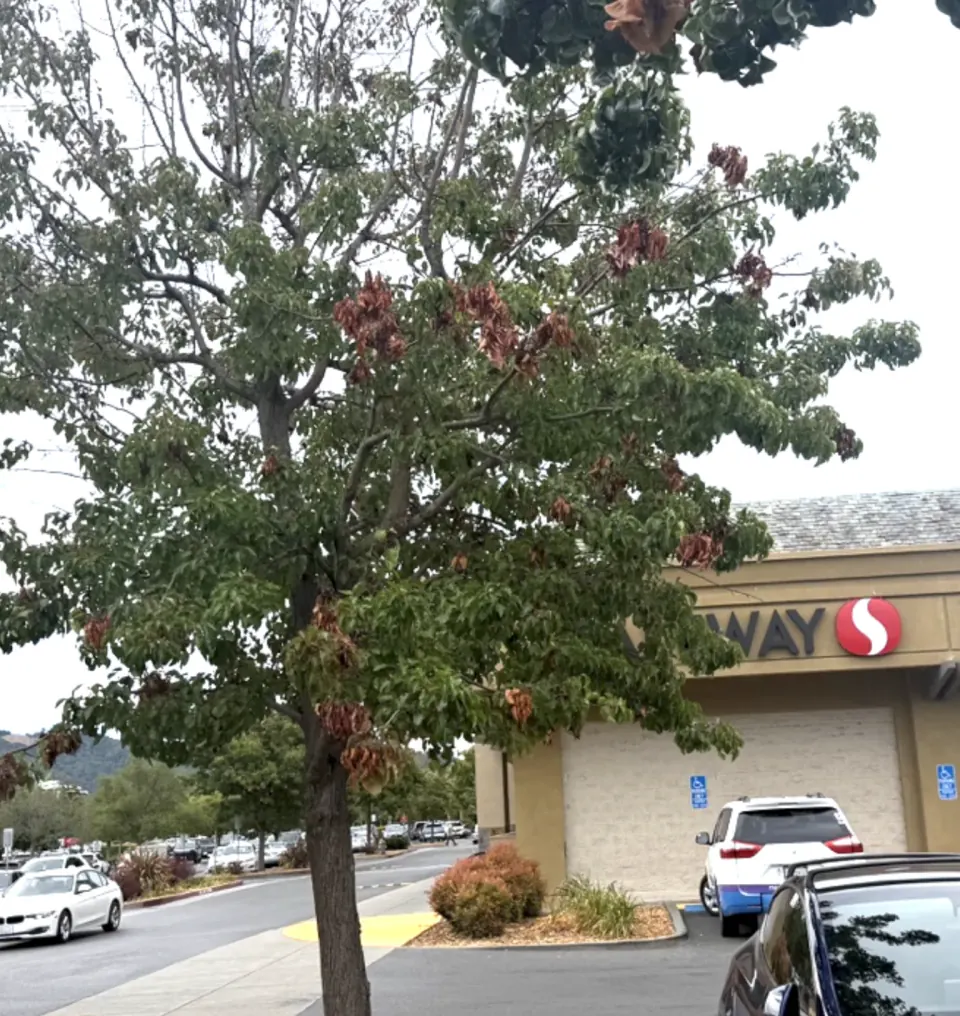
I've had a handful of calls this year about trees with fire blight. My family and I live in Terra Linda, and I've been spotting it all over the place: along Freitas Parkway, in the Safeway parking lot, and in front yards all over the neighborhood. If your tree's leaves have suddenly turned brown or black like they've been scorched, and they're still hanging on instead of falling off, this is probably what you're dealing with.
What Is Fire Blight?
Fire blight is a bacterial disease. It mainly attacks trees in the rose family – pears, apples, hawthorns, quince, and pyracantha. Once one tree in a yard gets infected, it tends to show up on the neighbor's tree not long after. If you've got a Bartlett or Starkrimson pear, that's worth knowing, because both varieties bloom longer than most, which means a longer stretch of the season where an open flower can catch the infection.
If you're planting a new apple tree, some varieties hold up better than others. 'Liberty' and 'Golden Delicious' tend to be more resistant, and 'Delicious' varieties usually do best of all. None of them are fully immune though, especially if a frost, hailstorm, or accidental damage opens up the bark.
How to Spot It on Your Tree
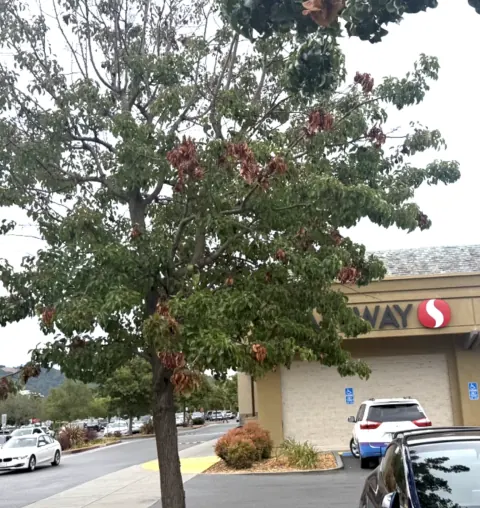
Look at the tips of the branches. Infected shoots often curl over into a hook shape – arborists call it a shepherd's crook. The leaves on that branch turn black or dark brown fast, almost like they got scorched, but they stay stuck to the branch instead of dropping. This stage is called shoot blight, and it's usually the first thing homeowners notice. Pear leaves tend to go black, while apple leaves usually turn a dark orange-brown instead.
You'll also see blossoms wilt and blacken in spring, and small amber-colored droplets oozing out of cracks in the bark or out of infected fruit. That ooze is the bacteria itself, and it's the main reason this spreads so fast between branches and between trees.
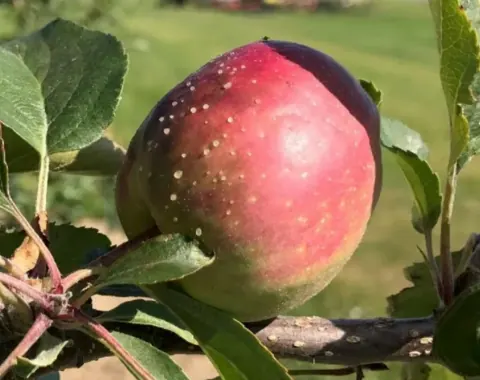
Bees Spread It
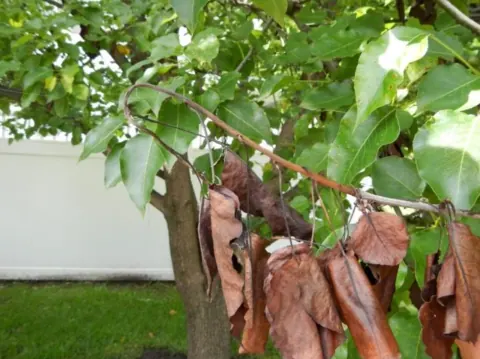
The bacteria that causes fire blight spends the winter in small cankers on the branches. When your tree blooms in spring, those cankers ooze bacteria, and bees pick it up while they're moving pollen from blossom to blossom. The same bees you want in your yard end up carrying the infection from tree to tree. Warm, wet spring weather speeds the whole thing up. This early stage – when it's just the blossoms getting hit – is what arborists call blossom blight.
Can the Tree Be Saved, or Should It Come Out?
This is the call I get asked to make most often, and there's no single answer. A young pear tree with one or two infected branches usually has a good shot with the right pruning. A tree that's already infected in the trunk or main scaffold branches, or one that keeps coming back year after year, is a different situation. At some point, cutting out infected wood just isn't worth it anymore, and removal is the more sensible call. I look at every tree on its own before making that recommendation.
How We Cut Fire Blight Out
Timing matters as much as technique. Pear trees get hit the hardest, so when we spot a new infection in spring, we cut it out right away and disinfect our shears between every cut, since the bacteria is actively on the move at that point. If the infection isn't racing through the tree, we'd rather wait until summer or the dormant winter months, once the damage has stopped spreading and the edge of it is easy to see. We trace the infected branch back to where it meets the next larger branch and cut there, not at some random spot a foot down. Leaving even a little infected wood behind because the cut was too close to the damage causes more reinfection than a missed tool wipe-down ever would.
A Couple Other Things That Help
Go easy on the nitrogen fertilizer if your pear tree has had fire blight before. Heavy fertilizing pushes out soft new growth that's more likely to get infected. And don't toss the branches you cut off into your compost pile – bag them up or haul them away instead.
If You're Seeing This in Your Yard
If your tree is showing signs like these, I'm happy to come take a look and tell you straight whether it's a pruning job or time to remove it. Reach out for a free estimate and we'll set up a time to come take a look.